In today’s interconnected world, security cameras have become ubiquitous, offering homeowners and businesses a powerful tool for protection and peace of mind. While video surveillance is widely accepted, the ability to record audio with these cameras introduces a complex layer of legal and ethical considerations, primarily concerning privacy. As technology advances, understanding the nuances of privacy laws surrounding audio recording on security cameras is more critical than ever to ensure compliance and avoid potential legal pitfalls.
What is Security Camera Audio Recording?
Security camera audio recording refers to the capture of sound alongside video footage from surveillance devices. Modern security cameras often come equipped with built-in microphones, allowing them to record conversations, ambient noise, and other sounds within their range. This capability can significantly enhance the evidentiary value of surveillance footage, providing crucial context that video alone might miss. For instance, in a theft scenario, audio might capture verbal threats or discussions among perpetrators, offering vital clues for identification and understanding motives.
Historically, surveillance focused primarily on visual data. However, as microphones became smaller and more integrated, audio recording emerged as a feature, promising a more comprehensive security solution. This evolution, while beneficial for security, has simultaneously heightened concerns about individual privacy, leading to a patchwork of laws designed to regulate its use.
Why Record Audio on Security Cameras?
The integration of audio into security camera systems offers several compelling advantages. Audio evidence can be invaluable for:
- Enhanced Evidence Collection: Audio recordings can capture verbal exchanges, cries for help, breaking glass, or specific sounds that might indicate an event, supplementing visual evidence and providing a more complete narrative of incidents. This can be crucial in investigations, legal proceedings, or insurance claims.
- Deterrence and Verification: The presence of audio recording capabilities can act as an additional deterrent to illicit activities. In situations like package theft or vandalism, clear audio of conversations or distinctive sounds can aid in identifying suspects and verifying events more accurately.
- Monitoring and Communication: For specific applications, such as monitoring children or elderly family members, or for two-way communication through a video doorbell, audio is essential. It allows for real-time interaction and better situational awareness.
- Understanding Motives: In complex situations, audio can help piece together the context of an event, providing insights into the intentions or discussions of individuals involved, which might not be apparent from video footage alone.
Despite these benefits, the legal landscape surrounding audio recording is significantly more restrictive than for video, largely due to the higher expectation of privacy people have regarding their conversations.
The Legal Landscape: Federal Laws
In the United States, several federal laws govern audio recording, forming the bedrock upon which state-specific regulations are built. These laws primarily aim to protect individuals from unauthorized interception of their communications.
The Wiretap Act (Title III of the Omnibus Crime Control and Safe Streets Act of 1968)
|
Our Picks for the Best Security Camera in 2026
As an Amazon Associate I earn from qualifying purchases.
|
||
| Num | Product | Action |
|---|---|---|
| 1 | TP-Link Tapo 1080P Indoor Security Camera for Baby Monitor, Dog Camera w/Motion Detection, 2-Way Audio Siren, Night Vision, Cloud & SD Card Storage, Works w/Alexa & Google Home (Tapo C100) |

|
| 2 | WYZE Cam Pan v3 Indoor/Outdoor IP65-Rated 1080p Pan/Tilt/Zoom Wi-Fi Smart Home Security Camera with Color Night Vision, 2-Way Audio, Compatible with Alexa & Google Assistant, White, 2-Pack |
|
| 3 | 2K Cameras for Home Security-Outdoor/Indoor Camera for Dog/Cat/Pet/Nanny/Baby/Elderly, Color Night Vision, White Light, Siren, 24/7 SD Recordings, Works with Alexa, Plug in (C1-White-2pack-2.4G) |
|
| 4 | WYZE Bulb Cam Security Camera, 2K HD Outdoor Light Bulb Camera, Color Night Vision, Dimmable LED Bulb, Motion Detection, Siren Alarm, Works w/Alexa/Google Assistant. Free Expert Support |
|
| 5 | Tapo 2K+ Indoor/Outdoor Wired Security Camera - 2024 PCMag Editors' Choice, Person/Pet/Vehicle Detection, Baby Monitoring, Color Night Vision, Subscription-Free Local Storage or Optional Cloud, C120 |
|
| 6 | Tapo 1080P Indoor Pan/Tilt Wired Security Camera - Works as a Baby & Pet Monitor, Motion Detection, 2-Way Audio, Siren, Night Vision, Subscription-Free Local Storage or Optional Cloud, Black, C201 |
|
| 7 | Google Nest Cam with Floodlight - Outdoor Camera - Floodlight Security Camera, White, 1 Count (Pack of 1) |
|
| 8 | 2K No Drill Window Camera-2 Pack 2.4Ghz & 5Ghz WiFi Cameras for Home Security for Indoor & Outdoor Monitoring, Anti-Glare Color Night Vision, Human Detection, 24/7 Recording, Ideal for Apartment, K1 |
|
| 9 | aosu Security Cameras Outdoor Wireless, 4 Cam-Kit, No Subscription, Solar-Powered, Home Security Cameras System with 360° Pan & Tilt, Auto Tracking, 2K Color Night Vision, Easy Setup, 2.4 & 5GHz WiFi |
|
| 10 | Google Nest Cam Outdoor (Wired, 2nd Gen) - 2 Pack - Security Camera with 2K Video and Gemini, Night Vision, 2-Way Audio - Works with Google Home - 2025 Model - Snow |
|
This foundational federal law strictly controls the interception of oral, wire, and electronic communications. For security camera use, it dictates that you generally cannot record a private conversation without at least one party’s consent. Violations of the Wiretap Act can lead to serious federal crime charges, including imprisonment and substantial fines. It’s why many businesses opt to disable audio recording entirely to mitigate risk.
Electronic Communications Privacy Act (ECPA) of 1986
The ECPA expanded the protections of the Wiretap Act to encompass digital forms of communication, such as emails, electronic messages, and stored voicemails. While primarily focused on digital data, it reinforces the principle that private electronic communications, including those captured by surveillance systems, must be handled with care and generally require consent for interception or access. Businesses storing footage or electronic data from cameras must ensure they comply with ECPA regulations regarding access and storage.
Video Voyeurism Prevention Act (VPA) of 2004
The VPA specifically addresses the recording of individuals’ intimate body parts in locations where there’s a reasonable expectation of privacy, such as bathrooms, changing rooms, and private residences, without their consent. While its primary focus is visual, it underscores the broader federal commitment to privacy in sensitive spaces. Deploying any camera, with or without audio, in such areas is a serious federal crime.
Video Privacy Protection Act (VPPA) of 1988
This Act prohibits the disclosure of personally identifiable information related to video rentals or similar services. While not directly about audio recording on security cameras, it highlights the federal emphasis on protecting personal information derived from recordings. If audio recordings contain personally identifiable details, their use and sharing could fall under broader privacy protections, requiring consent before dissemination.
Fair Credit Reporting Act (FCRA)
Though primarily regulating credit reporting, the FCRA contains provisions that can affect surveillance recordings. If information obtained from video or audio recordings is used for employment, credit, or insurance purposes, the individual must be notified beforehand and their consent obtained. This means that if security camera footage with audio is ever intended for such applications, compliance with FCRA is necessary.
Understanding Consent: One-Party vs. All-Party States
The most significant distinction in audio recording legality stems from state-specific consent laws. These laws determine how many individuals involved in a conversation must agree to be recorded for the act to be legal.
One-Party Consent States
In one-party consent states, audio recording is permissible if at least one person involved in the conversation is aware of and agrees to the recording. This person could be the camera owner, the operator, or any participant in the conversation. The majority of U.S. states follow this rule, offering more flexibility for security camera owners. However, even in these states, the recording must still respect private areas where an individual would have a reasonable expectation of privacy, regardless of consent.
All-Party Consent States
Also known as “two-party consent” states, these jurisdictions require every individual participating in a conversation to consent to the audio recording. Recording without the explicit agreement of all parties can lead to severe legal penalties, including criminal charges and civil lawsuits. Due to this heightened risk, many businesses and even homeowners in all-party consent states choose to disable audio recording features on their security cameras entirely.
Mixed Consent States
Some states operate under a hybrid model, where consent rules can vary depending on the nature of the communication (e.g., electronic vs. in-person) or other specific circumstances. This adds another layer of complexity, requiring careful review of local statutes.
To provide a general overview, the following table summarizes typical audio consent types by state, though it is critical to consult specific state statutes for definitive legal advice.
| State | Audio Consent Type |
|---|---|
| Alabama | One-party consent |
| Alaska | One-party consent |
| Arizona | One-party consent |
| Arkansas | One-party consent |
| California | All-party consent |
| Colorado | One-party consent |
| Connecticut | All-party consent |
| Delaware | All-party consent |
| Florida | All-party consent |
| Georgia | One-party consent |
| Hawaii | Mixed consent |
| Idaho | One-party consent |
| Illinois | All-party consent |
| Indiana | One-party consent |
| Iowa | One-party consent |
| Kansas | One-party consent |
| Kentucky | One-party consent |
| Louisiana | One-party consent |
| Maine | Mixed consent |
| Maryland | All-party consent |
| Massachusetts | All-party consent |
| Michigan | One-party consent |
| Minnesota | Mixed consent |
| Mississippi | One-party consent |
| Missouri | One-party consent |
| Montana | All-party consent |
| Nebraska | One-party consent |
| Nevada | Mixed consent |
| New Hampshire | All-party consent |
| New Jersey | One-party consent |
| New Mexico | One-party consent |
| New York | One-party consent |
| North Carolina | One-party consent |
| North Dakota | One-party consent |
| Ohio | One-party consent |
| Oklahoma | One-party consent |
| Oregon | Mixed consent |
| Pennsylvania | All-party consent |
| Rhode Island | One-party consent |
| South Carolina | One-party consent |
| South Dakota | One-party consent |
| Tennessee | One-party consent |
| Texas | One-party consent |
| Utah | One-party consent |
| Vermont | Mixed consent |
| Virginia | One-party consent |
| Washington | All-party consent |
| West Virginia | One-party consent |
| Wisconsin | One-party consent |
| Wyoming | One-party consent |
Disclaimer: This table is for informational purposes only and not legal advice. Laws can change, and specific situations may have unique legal interpretations. Always consult local legal counsel for specific guidance.
Key Legal Considerations
Beyond federal and state consent laws, several other factors significantly impact the legality of audio recording with security cameras.
Expectation of Privacy
This is a fundamental concept in privacy law. Individuals generally have a “reasonable expectation of privacy” in certain places, such as bathrooms, bedrooms, locker rooms, and private offices. Recording audio or video in these areas, even if you own the property, is almost universally illegal and can lead to severe criminal charges. Conversely, in public areas like streets, parks, or the exterior of a business, the expectation of privacy is significantly reduced.
Public vs. Private Spaces
The distinction between public and private spaces is crucial. Recording video in public or semi-public areas (like a store floor or a public-facing driveway) is generally allowed. However, audio recording in these same areas can be restricted, especially in all-party consent states, because conversations often carry a higher expectation of privacy than visual presence. Even in one-party consent states, discreetly recording conversations in a public setting where someone genuinely believes their conversation is private could still lead to legal challenges.
Home vs. Business Settings
The rules can also differ based on whether cameras are used in a residential or commercial environment.
- Residential: Homeowners usually have more leeway to record on their own property. However, they must still respect neighbors’ privacy, avoiding pointing cameras into their private yards or through windows. They also owe privacy to anyone living or visiting their home, particularly in common areas or guest rooms, where an expectation of privacy may exist.
- Business: Businesses typically face stricter guidelines. Many states require conspicuous signage notifying customers and employees that surveillance (including audio, if enabled) is in use. Workplace monitoring also has specific regulations; employees generally need to be informed, and cameras are strictly prohibited in private areas like restrooms or changing rooms. To avoid litigation, many businesses disable audio recording on their surveillance systems.
Notice Requirements (Signage)
For businesses and sometimes even homeowners, providing clear notice of surveillance is a best practice and often a legal requirement. Visible signs stating “Audio and Video Surveillance in Use” can serve as implied consent, particularly in one-party consent states, as individuals are presumed to have agreed to be recorded by entering the premises. In all-party consent states, signage alone may not be sufficient for audio, requiring more explicit forms of consent.
Navigating Audio Recording Legally
For security camera owners, proactive steps are essential to ensure legal compliance when considering audio recording.
Determine Your Needs and Location
Before enabling audio, clarify why you need it. Is it critical for your security objectives, or is video sufficient? Consider the specific location: Is it a public-facing area, a private indoor space, or a workplace? The legal restrictions intensify as you move into more private environments.
Research State Laws Thoroughly
This is the most critical step. Do not assume. Research your specific state’s (and potentially your county’s or city’s) laws regarding audio recording and consent. Understand whether it is a one-party, all-party, or mixed-consent state. Ignorance of the law is not a valid defense.
Prioritize Privacy Features
Many modern security cameras offer privacy features. These can include:
- Privacy Zones: Allowing you to black out specific areas of the video feed that should not be recorded.
- Audio Disabling: The ability to turn off the microphone entirely.
- Motion-Activated Recording (Video Only): Recording only when motion is detected, without necessarily capturing continuous audio.
Utilize these features to minimize privacy intrusion and legal risk.
Seek Legal Counsel
When in doubt, especially for business applications or complex residential setups, consult with a legal professional specializing in privacy and surveillance law. They can provide tailored advice based on your specific situation and local regulations.
Common Pitfalls and How to Avoid Them
Even with good intentions, several common mistakes can lead to legal trouble when recording audio.
Recording Without Consent
This is the most frequent and serious pitfall. Failing to obtain the necessary consent (one-party or all-party, depending on your state) for audio recording can result in criminal charges, hefty fines, and civil lawsuits. Always prioritize consent.
Misusing or Sharing Recordings
Even if a recording is legally obtained, its misuse or unauthorized sharing can violate privacy. Posting private conversations on social media, using recordings for purposes other than stated security objectives, or disseminating sensitive information can lead to legal action, reputational damage, and breaches of trust.
Ignoring “Expectation of Privacy”
Placing cameras, especially those with audio, in areas where people have a reasonable expectation of privacy (e.g., bathrooms, changing rooms, inside a neighbor’s window) is illegal regardless of consent laws. These are absolute no-go zones.
Lack of Clear Notice
For businesses, failing to post clear, conspicuous signs informing individuals of audio and video surveillance can nullify any claim of implied consent and lead to legal challenges. Always make surveillance transparent.
Best Practices for Compliant Audio Recording
To leverage the benefits of security camera audio while respecting privacy and legal boundaries, adopt these best practices:
Display Clear Signage
For any area under surveillance, especially commercial properties, post prominent and easily readable signs explicitly stating that both video and audio recording are in progress. This serves as a vital notice and can fulfill consent requirements in one-party consent states.
Disable Audio in Sensitive Areas
If your camera covers areas where privacy is expected or where all-party consent is required and difficult to obtain, disable the audio recording feature. Often, video-only surveillance is sufficient for security purposes and carries significantly less legal risk.
Secure Your Recordings
Implement robust security measures for storing and accessing recorded footage and audio. Limit access to authorized personnel only, use encryption, and adhere to data retention policies. This prevents unauthorized access, misuse, and potential data breaches.
Regularly Review Laws
Privacy and surveillance laws are dynamic and can change. Stay informed about federal, state, and local regulations. Periodically review your surveillance practices to ensure ongoing compliance, especially if you upgrade your system or expand coverage.
> “While audio recording can significantly enhance security, it’s a legal minefield. Property owners must navigate federal and state laws, prioritize consent, and always respect an individual’s reasonable expectation of privacy to avoid severe repercussions.” – A Security Law Expert
Conclusion
The question “Is audio recording legal on security cameras?” reveals a complex legal landscape shaped by federal statutes and varied state-specific consent laws. While the ability to capture sound offers valuable security advantages, it also carries substantial privacy implications. Understanding the distinction between one-party and all-party consent states, coupled with a deep respect for individuals’ reasonable expectation of privacy, is paramount. By adhering to best practices—including clear signage, thoughtful placement, and, when necessary, disabling audio in sensitive areas—security camera owners can harness this powerful technology responsibly. Ultimately, responsible deployment of security cameras with audio requires diligence and a commitment to legal compliance to ensure safety without infringing on fundamental privacy rights. Are you fully aware of the audio recording laws in your area?
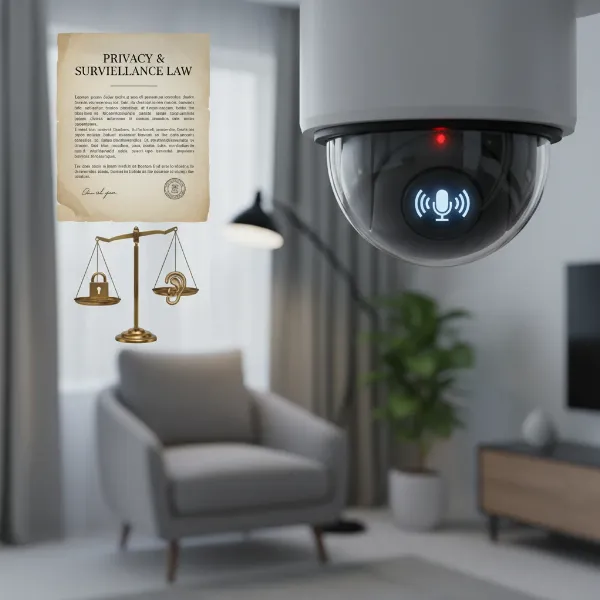 Security camera recording audio in a setting with privacy concerns, illustrating legal implications
Frequently Asked Questions
Is it legal to record conversations in my own home with a security camera?
The legality of recording conversations in your own home depends on your state’s consent laws. In one-party consent states, it’s generally legal if you (as the camera owner) are a party to the conversation or consent to its recording. However, in all-party consent states, you would need everyone involved in the conversation to agree, which can be challenging to prove. Regardless, recording in private areas like bathrooms is strictly prohibited.
What is the difference between one-party and all-party consent laws?
One-party consent laws allow audio recording if at least one person involved in the conversation gives permission. All-party (or two-party) consent laws require every single person participating in the conversation to consent to the recording. The majority of U.S. states are one-party consent, but several key states are all-party consent.
Can I record audio on outdoor security cameras?
Recording audio on outdoor Security Cameras is subject to the same federal and state consent laws as indoor cameras. While video recording in public-facing outdoor areas (like your driveway or sidewalk) is often permissible, capturing conversations without consent, especially from neighbors or passersby, can violate privacy laws, particularly in all-party consent states or if there’s a reasonable expectation of privacy.
Do I need to put up signs if my security camera records audio?
Yes, it is highly recommended to put up clear, visible signs indicating both video and audio surveillance is in use, especially for businesses. This serves as a form of implied consent and can help protect you legally, particularly in one-party consent states. In all-party consent states, signage alone may not be sufficient for audio recording.
What are the penalties for illegal audio recording?
Penalties for illegal audio recording can range from civil lawsuits (with significant monetary damages) to criminal charges, including federal wiretapping charges, which can carry heavy fines and imprisonment. The severity of the penalty often depends on the jurisdiction, the nature of the violation, and whether the recording was in an area with a high expectation of privacy.